How Do You Choose a Mini Sauna Heater for a Small Sauna?
Choose a mini sauna heater by matching its documented room-volume range to your sauna, then checking installation space, electrical requirements and controls. The smallest heater body is only one part of the decision.
For retailers, distributors and sauna project buyers, a useful comparison also includes what comes with the heater, which documents are available and how the product will be supported after delivery.
This guide focuses on compact electric heaters for traditional sauna rooms. It explains what to compare before choosing a model or requesting a wholesale quotation.
1. Start with the Sauna Room
Before comparing heater designs, prepare the room’s internal dimensions and construction details.
For a rectangular room, the starting calculation is:
Internal length × internal width × internal height = room volume
For example, a room measuring 1.5 × 1.2 × 2.0 metres has a geometric volume of 3.6 m³. This is a measurement example, not a heater recommendation.
Construction matters too. Glass and exposed heat-storing surfaces can increase the heating requirement. Harvia’s sauna sizing guidance considers both room volume and construction when assessing heater power.
Use the sizing instructions for the exact heater under consideration. Share a room drawing and details of glass, insulation and wall materials with the supplier before confirming a model.
A description such as “two-person sauna” is useful for marketing, but it does not provide enough information for heater selection.
2. Compare the Installed Space, Not Just the Body Dimensions
A buyer searching for the smallest sauna heater may be trying to preserve bench space or fit a narrow layout.
Compare the full installation arrangement:
- Heater body dimensions
- Permitted mounting position
- Required clearances
- Space for any specified guard
- Access to controls
- Space needed for maintenance
Ask for the installation drawing alongside the product photograph. A compact-looking heater may need a different layout from the one suggested by its dimensions alone.
For a repeatable sauna cabin design, review the heater and cabin drawings together before approving the sample.

3. Compare Mini Sauna Heater Models on the Same Basis
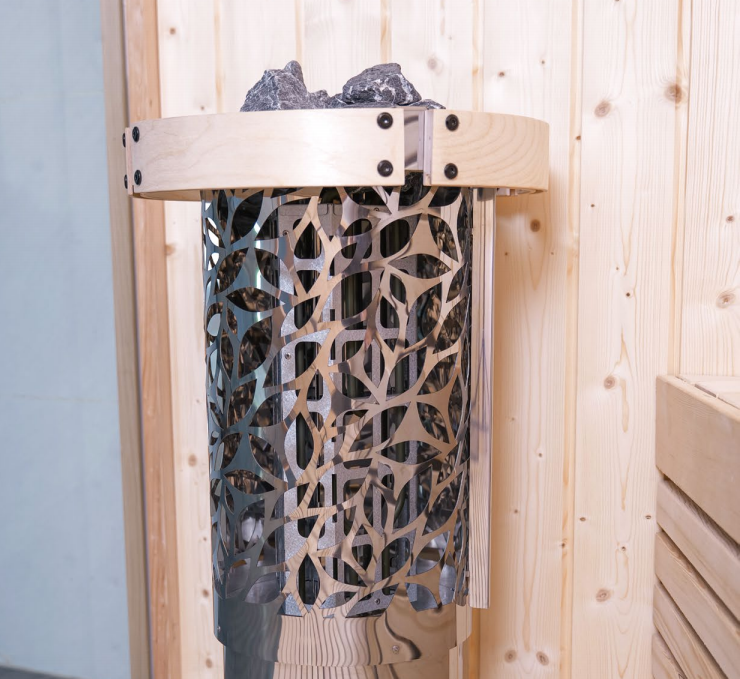
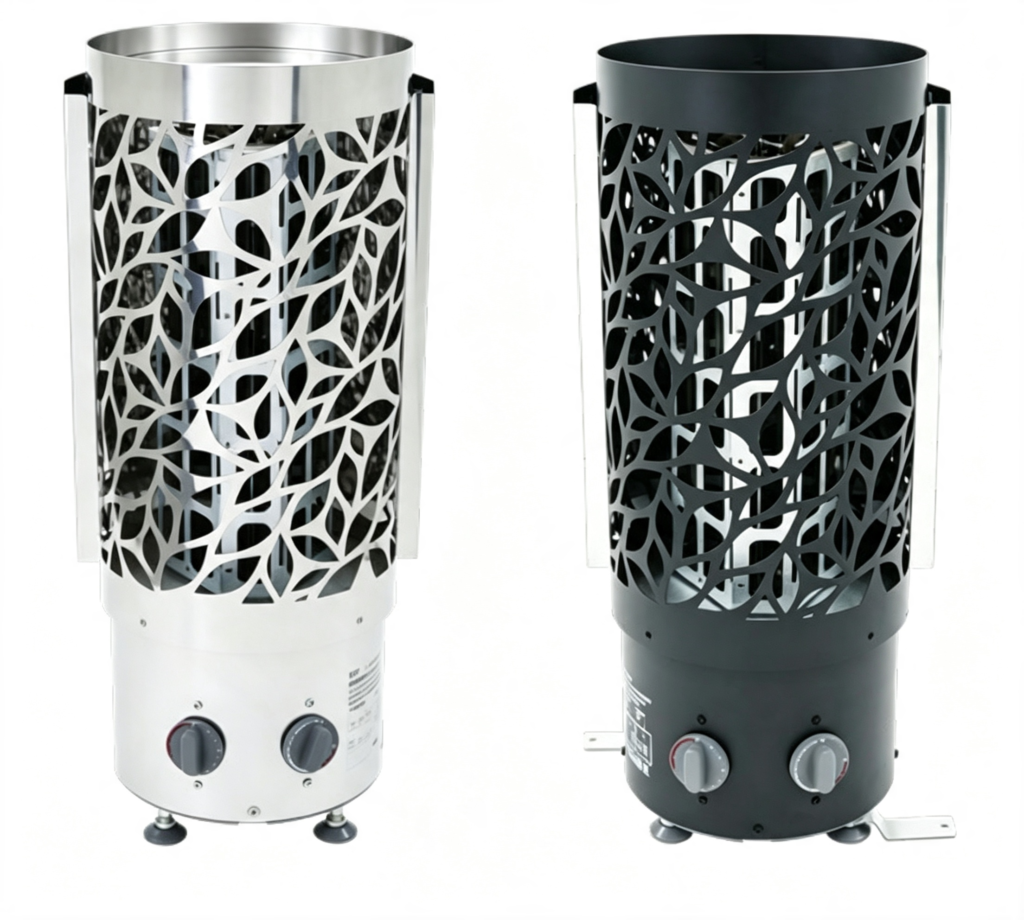
Mai Sauna’s published product information provides two examples of compact heaters with different formats.
| Specification | Complex Mini | Pillar Mini |
|---|---|---|
| Documented output | 3 kW | 3 kW |
| Published recommended room volume | 2–4 m³ | 2–4 m³ |
| Controls | Built-in timer and thermostat | Built-in timer and thermostat |
| Placement | Floor-standing or wall-mounted | Floor-standing |
| Published dimensions | 320 × 265 × 600 mm, floor-standing; 340 × 265 × 650 mm, wall-mounted | 280 × 300 × 680 mm |
| Stone capacity | 10 kg | 25 kg |
See the Complex Mini Heater and Pillar Mini Heater product pages for the published configurations.
Confirm the final specification and installation requirements for your order.
The comparison shows why a single measurement can be misleading. The Pillar Mini is narrower, while the floor-standing Complex Mini is shallower and shorter. The suitable choice depends on the room layout and documented installation arrangement.
Stone capacity also differs. Ask whether stones are included in the quotation rather than assuming that pictured accessories are supplied.
4. Decide How Customers Will Use the Controls
Control placement affects both the room design and the customer experience.
Built-In Controls
For a heater with integrated controls, review their position in the proposed layout. Can the user see and operate them as intended once the benches and any guard are in place?
Include control access in the sample review, rather than checking only the heater’s appearance.
External Controls
If you prefer a separate panel, ask for a complete system quotation. Request a list identifying the heater, compatible controller, sensors and any required power unit.
When reviewing sauna controller options, confirm compatibility with the exact heater model. A similar-looking panel is not enough to establish that the components work together.
If app or remote operation is part of your retail brief, request written confirmation of the supported configuration and its operating conditions.
5. Match the Product to the Intended Application
A mini sauna heater should be assessed against a defined project.
Compact Residential Sauna Projects
Provide the room drawing and planned electrical supply. For a cabin range, identify which room versions the proposed heater will accompany.
If customers can add a larger glass front or change the layout, include those options in the review instead of assuming one heater specification covers every version.
Retail Product Ranges
Give customers a clear way to compare models. Useful product-page fields include output, recommended room volume, dimensions, control arrangement and supplied components.
Keep model names and specification tables consistent across the website, quotation, packaging and manual. This makes it easier for a buyer to identify the correct configuration.
Hotels, Spas and Other Managed Facilities
Describe the intended operating pattern, who will control the heater and how servicing will be arranged.
Ask the supplier to confirm suitability for that application. A small room alone does not establish that a model is appropriate for the proposed operating schedule.
6. What Should Buyers Confirm Before Ordering?
A useful quotation should make the scope of supply clear enough to compare with another offer.
Ask the supplier to confirm:
- Exact model and configuration
- Rated output and electrical requirements
- Documented room-volume range
- Installation arrangement and drawing
- Control system and included components
- Stones, guards and mounting items included in the price
- Available instructions and technical documents
- Sample cost and delivery arrangements
- Order quantity, packaging and lead time
- Warranty terms and replacement-part support
For market-specific documentation, identify the destination country and exact product configuration in the enquiry. Ask which documents are available for that configuration and arrange the appropriate review before ordering.
Electrical planning and installation should follow the selected product’s instructions and be handled by qualified personnel. Do not infer installation requirements from another heater with the same power rating.
Compare Complete Offers
A lower quoted unit price may cover a different package.
One offer may include a controller while another lists it separately. Packaging, stones, spare parts and delivery terms may also differ.
Create one comparison sheet with the same fields for every quotation. Mark missing details as questions rather than filling them with assumptions.
7. Review a Sample Before Building a Product Range
For a new retail line, use the sample stage to resolve practical questions before committing to the final presentation.
Check whether:
- The sample matches the quoted model
- Dimensions match the supplied drawing
- Controls and labels are easy to identify
- The contents match the packing list
- Instructions identify the correct configuration
- Packaging protects the product as intended
Have any operational assessment performed under suitable installation conditions by qualified personnel.
Record the approved sample configuration with photographs and a written specification. If the final order differs from the sample, document the change before production.
This also gives the marketing team a reliable basis for photography and product descriptions.
8. Wholesale and Private Label Planning
For a private label mini sauna heater project, prepare a short brief before discussing logos and packaging.
Include the target market, intended customer, preferred heater format, control arrangement and expected order quantity. Then ask which branding and packaging options are available for the confirmed model.
Useful questions include:
- Can the packaging carry our brand and model reference?
- What artwork files are required?
- Which labels must remain on the product?
- Who prepares and checks the instruction manual?
- Does customization change the minimum order or lead time?
- How will replacement parts be identified?
Agree on the technical configuration before finalizing packaging claims. The carton, manual and online listing should describe the same product.
Mai Sauna’s sauna heater range includes compact models and supports wholesale and OEM enquiries, with project details subject to the confirmed specification.
Frequently Asked Questions
What is the smallest sauna heater?
There is no single useful answer without defining the room and installation requirements. Compare width, depth, height, clearances and control access. The smallest body may not create the most practical installed layout.
Is a 3 kW heater suitable for every small sauna?
No. Check the selected model’s documented room range and assess the actual room construction. “Small” does not describe the full heating requirement.
Are stones and controls included?
Check the written quotation. Ask for an itemized scope of supply, especially when comparing integrated-control and external-control models.
Can I order a mini sauna heater with my own branding?
Discuss branding options for the selected model and order quantity. Confirm the packaging, labels, instructions and approval process before committing to the project.
Final Thoughts
A well-chosen mini sauna heater starts with a clear room specification.
Compare the heating requirement, installed space and controls first. Then review the complete quotation, sample and supporting documents.
For retailers and project buyers, this creates a stronger product offer: customers can understand which configuration they are buying, what is included and what needs to be confirmed for installation.